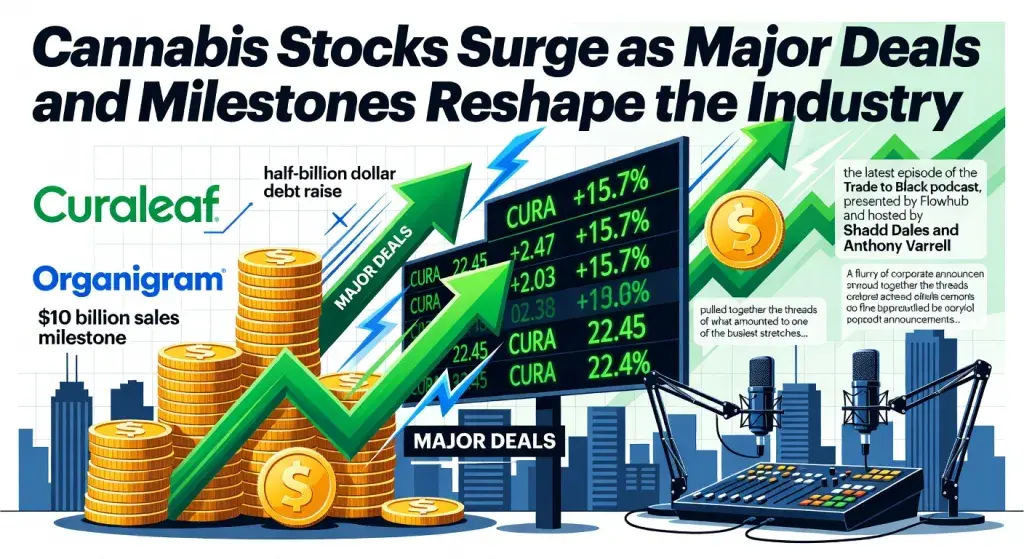
A flurry of corporate announcements, a half-billion-dollar debt raise, and a $10 billion sales milestone in Massachusetts all landed in the same week - and the cannabis sector's equity markets noticed. The latest episode of the Trade to Black podcast, presented by Flowhub and hosted by Shadd Dales and Anthony Varrell, pulled together the threads of what amounted to one of the busiest stretches on the business side of legal cannabis in months.
Big Capital Moves: Curaleaf and Organigram
The headline number belongs to Curaleaf, which closed a $500 million private placement of senior secured notes carrying an 11.5% coupon and maturing in 2029. That's a steep interest rate by any standard - a reflection of the risk premium still embedded in cannabis capital markets, where federal illegality in the United States continues to wall off cheaper sources of financing. For Curaleaf, the raise signals confidence in its cash-flow trajectory, but the cost of that capital tells its own story about where the industry sits on the institutional credibility curve.
Organigram, meanwhile, announced a $65.2 million private placement linked to its acquisition of Germany's Sanity Group, with backing from British American Tobacco. The involvement of BAT isn't incidental. It represents one of the more concrete examples of legacy tobacco capital flowing directly into cannabis expansion - and the target is Europe, not North America. Germany's evolving regulatory framework for cannabis has made it arguably the most closely watched market on the continent, and Organigram is making an aggressive bet that early positioning there will pay off.
Rubicon Organics and the Art of the Value Acquisition
Margaret Brodie, CEO of Rubicon Organics, joined the podcast to discuss the company's first completed harvest at its newly licensed Cascadia facility in British Columbia. The numbers here are worth sitting with. Rubicon acquired the roughly 50,000-square-foot indoor grow for $4.5 million and put another $1.5 million into capital improvements - $6 million total against a replacement cost Brodie pegged at $18 to $20 million. That's buying at roughly 30 cents on the dollar. The facility received its Health Canada cultivation license in October, is now fully planted, and is expected to boost Rubicon's production capacity by 40%.
In an industry littered with overbuilt, overleveraged facilities changing hands at distressed prices, this is what a disciplined acquisition looks like. Whether the additional capacity translates into margin expansion depends on Rubicon's ability to move premium product - the company operates in the craft segment - but the cost basis gives them room to maneuver.
Equities Catch a Bid - and Massachusetts Crosses $10 Billion
Cannabis stocks posted sharp gains on Thursday. Verano Holdings climbed 17.3%. Terrace Global surged 27%. YCBD rose 26%. All on a day when options on several cannabis names were set to expire - which likely amplified the moves. Still, the breadth of the rally suggested something more than mechanical: a sector that had been beaten down finding a reason, or several, to reprice.
On the policy front, Massachusetts quietly crossed a striking threshold - $10 billion in cumulative legal marijuana sales since voters approved adult-use legalization in 2016. Recreational sales in 2025 alone have reached $1.65 billion, and the state's Cannabis Control Commission expects consumption lounges to add a new revenue layer in 2026. That's a mature market generating real tax revenue and still finding room to grow.
Not every state is moving in the same direction, though. Arizona senators are advancing bills that would classify "excessive" marijuana smoke and odor as a nuisance crime - even on private property. Arizona legalized adult-use cannabis in 2020. The whiplash is instructive: legalization doesn't settle the cultural and regulatory arguments. It just opens new fronts.
What the Week Actually Tells Us
Zoom out, and the contours of this week sketch a sector in an awkward middle passage. Capital is available - but expensive. Acquisitions are happening - at pennies on the dollar because so many operators overextended. Sales milestones are real - but regulatory headwinds keep materializing in unexpected places. International expansion is underway - but dependent on foreign regulatory frameworks that remain works in progress. The cannabis industry is growing up. It just isn't growing up evenly, or cheaply, or without contradiction.