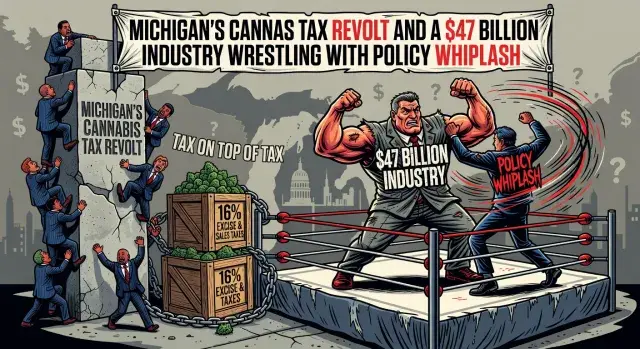
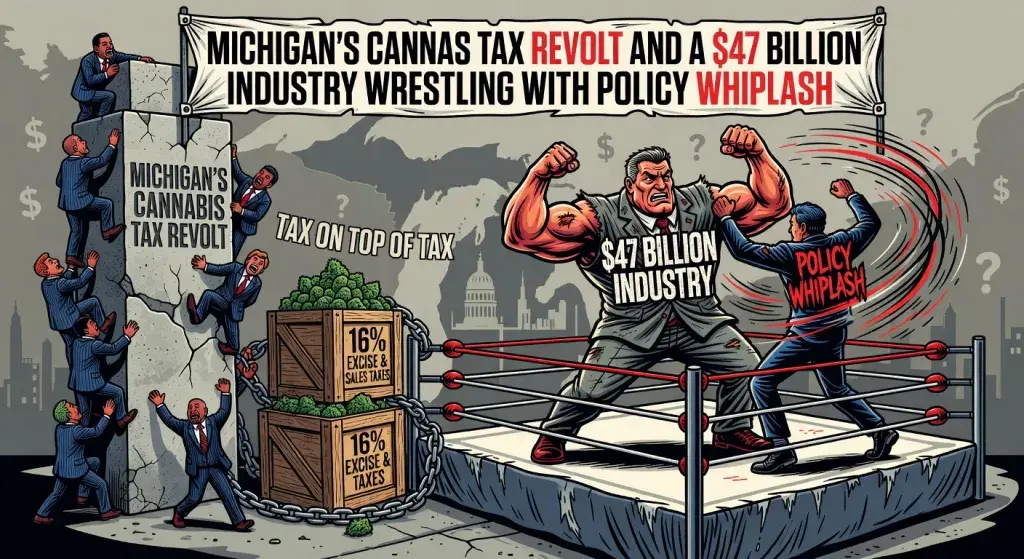
Eight bipartisan state senators in Michigan are pushing to repeal a 24 percent wholesale cannabis tax that took effect January 1st - a levy stacked on top of existing excise and sales taxes in a market already buckling under oversupply and compressed margins. The effort, dissected on the latest episode of Trade To Black presented by Flowhub, arrives as the broader U.S. cannabis industry eyes $47 billion in projected 2026 revenue while grappling with regulatory uncertainty on multiple fronts.
The Michigan Problem: Tax on Top of Tax
Here's the arithmetic that has operators furious. Michigan already imposes a combined 16 percent in excise and sales taxes on cannabis. The new wholesale tax adds another 24 percent upstream - a layer that was projected to generate roughly $421 million annually for the state. On paper, that's a windfall. In practice, it's a gut punch to a supply chain that can't absorb it.
Adam Stettner, CEO of cannabis lender FundCanna, joined hosts Shadd Dales and Anthony Varrell to lay out the damage. His firm has deployed nearly $40 million across more than a thousand files in Michigan, so the data isn't abstract for him. January dispensary sales fell 8.3 percent year over year, and Stettner warned that the retail numbers may not yet reflect the full impact - the tax is still working its way down the supply chain like a slow poison. The worst, he suggested, is probably still ahead.
Stettner called the tax "illogical," a word that lands harder when you consider the context. Michigan's cannabis market is already one of the most oversaturated in the country. Prices have been falling. Margins are thin. Layering a punitive wholesale tax onto that environment doesn't just squeeze operators - it risks collapsing the weakest ones entirely. FundCanna hasn't pulled out of the state, but it has tightened its debt service thresholds. A measured response, not a retreat. Not yet.
What Stettner described as "policy whiplash" - regulators acting without understanding downstream effects - is a recurring pattern in cannabis. States legalize, build markets, attract capital, then impose fiscal demands that the underlying economics can't support. If the repeal effort moves quickly, Stettner expressed cautious optimism that the market could absorb the disruption without permanent structural damage. That's a big "if."
The Bigger Picture: $47 Billion and the Demographic Shift
Flowhub CEO Kyle Sherman joined the second segment with a set of industry projections that paint a very different picture from Michigan's troubles. The U.S. cannabis industry could reach $47 billion in revenue in 2026, a number that reflects both expanding legal markets and shifting consumer demographics.
Some of Sherman's stats are striking. Sixty-four percent of cannabis consumers report using the product primarily for relaxation - not pain management, not recreation in the party sense, but a deliberate unwinding. More than one in three women over 21 now consume cannabis. And a quarter of all sales are now initiated online, primarily as pre-orders for in-store pickup - a hybrid commerce model that has quietly become standard.
Sherman also addressed artificial intelligence's creeping role in the industry. Call center jobs, he noted, are already being replaced by AI agents. But retail floor positions - the budtenders, the in-store consultants - are likely to remain human-driven for the foreseeable future. The product is too tactile, too personal, too dependent on trust for a chatbot to handle well. Fair enough.
Washington Waits, and So Does the Market
Cannabis equities held relatively steady on Wednesday, but the patience is visibly fraying. Investors have been waiting for a federal rescheduling announcement that keeps not arriving. The prolonged silence from Washington is its own kind of policy signal - one that reads, to the industry, as indifference dressed up as deliberation.
The Farm Bill hearing that anchored the episode's opening added another thread to an already tangled regulatory picture. Meanwhile, Flowhub's Great American Dispensary Tour filmed its latest episode in Washington, D.C., highlighting an absurdity that captures the whole mess in miniature: a district where cannabis is legal on certain sidewalks and a federal crime on the property just steps away. The geography of legality, measured in feet.
That tension - between a $47 billion market barreling forward and a regulatory framework that still can't decide what cannabis is - defines the industry in 2026. Michigan's tax revolt is just the loudest symptom of a deeper dysfunction: an industry building at scale on a foundation that keeps shifting beneath it.