
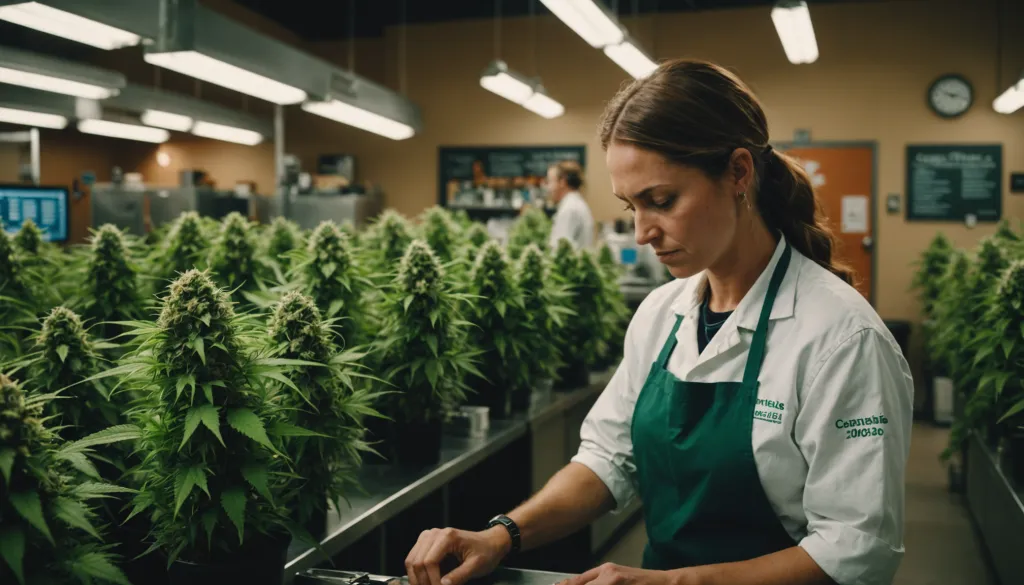
Across licensed cannabis markets in the United States, dispensary operators are confronting a familiar but intensifying pressure: how to staff and retain a compliant, trained workforce while managing thin margins and rising operational costs. The issue isn't new, but the scale of movement - budtenders, compliance officers, and store managers shifting between operators - has accelerated as the adult-use market matures and competitive wages rise across the retail sector broadly.
The dynamics differ sharply by state. In high-volume adult-use markets, turnover at the point-of-sale level can undercut the consistency that regulators expect in age-verification protocols, seed-to-sale tracking accuracy, and compliant product handling. Resources like https://indicaonline.com/markets/nevada/ illustrate how market-specific operational requirements - licensing conditions, METRC reporting obligations, purchase limits - shape the staffing decisions dispensary owners make on a daily basis. In a regulated environment, a poorly trained employee isn't just a customer service problem; it's a compliance liability that can surface in an audit or a state inspection.
Multi-state operators have an advantage here, at least on paper. They can build centralized training infrastructure, standardize POS terminal workflows across locations, and deploy compliance logs that travel with the employee record. In practice, though, state-by-state regulatory variance means that a budtender trained in one adult-use market may need significant retraining before working the floor in another. Packaging rules differ. Excise tax disclosures differ. What counts as a compliant sale varies enough that assuming transferable knowledge is a real operational risk.
Compliance Costs Are a Staffing Cost, Whether Operators Track It That Way or Not
Here's the catch that many smaller single-store operators miss: the cost of compliance isn't confined to the compliance officer's salary or the software subscription for seed-to-sale tracking. It lives in training hours, in the time a shift supervisor spends reviewing METRC entries, in the product batches that get pulled from the wholesale menu because a COA doesn't meet state testing thresholds, and in the overtime that accrues when a short-staffed dispensary tries to process end-of-day inventory reconciliation accurately. Every one of those line items connects back to labor.
Section 280E of the federal tax code compounds the problem. Because cannabis remains a Schedule I controlled substance federally, most dispensary operators cannot deduct ordinary business expenses - including payroll - the way a conventional retailer can. That structural tax burden means that every dollar spent on workforce development carries a heavier real cost than it would in, say, a licensed liquor retail environment. Operators who don't account for this when modeling labor costs tend to find themselves cash-constrained well before year-end.
What Smart Operators Are Doing Differently
The dispensaries managing workforce pressure most effectively are treating compliance training as a retention tool, not just a regulatory requirement. That sounds simple. It isn't. It requires a genuine investment in structured onboarding - not a one-hour orientation and a copy of the state regulations - and it requires POS systems configured to catch errors at the point of transaction rather than flagging them in a compliance log three days later. A good point-of-sale system doesn't replace a trained employee, but it does reduce the margin for error in high-traffic hours when budroom inventory is moving fast.
Inventory shrinkage is another pressure point that directly intersects with staffing quality. In a licensed cannabis operation, shrinkage isn't just a loss-prevention issue - it's a regulatory discrepancy that can trigger a state inquiry. Accurate SKU management, tight delivery manifest reconciliation, and disciplined product batch tracking all depend on employees who understand why these procedures exist, not just how to perform them mechanically. That's a training and culture question as much as a technology question.

The Broader Market Signal for B2B Suppliers and Technology Vendors
For the vendors - software providers, compliance consultants, POS manufacturers, wholesale distributors - serving the licensed cannabis space, the workforce story is a market signal worth reading carefully. Operators under staffing pressure are looking for tools that reduce the human error surface, not tools that require additional training to implement. A platform that demands a two-week onboarding period before a dispensary employee can use it confidently is solving the wrong problem. What the market actually needs, and what the stronger vendors are beginning to deliver, is software that integrates compliance checkpoints into routine transaction flows so that the right behavior is also the easy behavior.
The regulated cannabis retail sector is still finding its operational footing. Labor markets, compliance requirements, and tax structures create a combination of pressures that most other retail categories simply don't face at the same intensity. Operators who treat workforce strategy as a compliance function - not just an HR function - are better positioned to maintain their licenses, serve their customers responsibly, and survive the margin compression that defines this market right now.