New Jersey's Senate Judiciary Committee voted unanimously on Oct. 15 to advance two bills that will reshape how the state treats intoxicating hemp products and unlicensed cannabis sales. One measure syncs state law with a delayed federal hemp ban; the other turns illegal cannabis and vapor product sales into felony-level offenses with steep fines. Taken together, the pair signals lawmakers are willing to move fast on some fronts of cannabis policy while licensed operators say they're still waiting their turn.
A Moving Federal Deadline, And New Jersey Scrambles To Match It
Senate Bill 4635 exists because Washington keeps changing the clock. Congress originally set a federal ban on most intoxicating hemp products for mid-November, then pushed part of that deadline to Dec. 11, 2026, after passing a reprieve in early September. The federal rule redefines hemp as cannabis containing no more than 0.3% total THC on a preharvest field test, and it bars finished products with synthetic cannabinoids, cannabinoids the plant can't naturally produce, or more than 0.4 milligrams of total THC per container. One category - cannabinoids not naturally producible by the plant - stays banned on the original Nov. 12 date regardless.
S.B. 4635 builds in flexibility so New Jersey doesn't get caught flat-footed again. Rather than locking in a fixed date, the bill lets state law shift automatically whenever the federal definition actually changes. In practice, that means hemp products sold by businesses licensed through the Division of Alcoholic Beverage Control or the Cannabis Regulatory Commission stay legal until Washington's rule takes real effect - not a moment sooner or later than federal law dictates.
Licensed Operators See A Double Standard
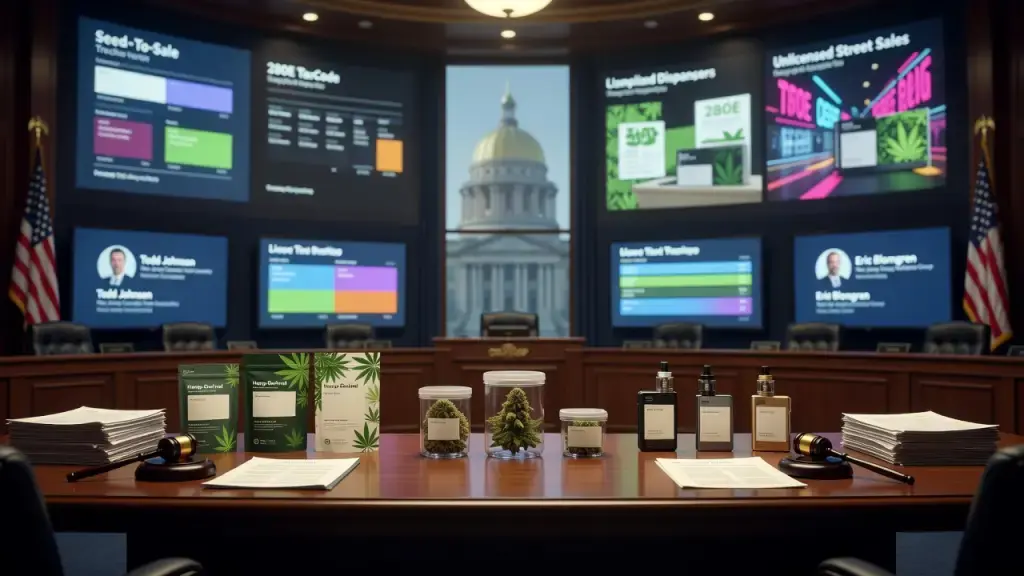
Todd Johnson of the New Jersey Cannabis Trade Association didn't oppose the bill outright, but his testimony drew a sharp line. He pointed out that lawmakers have extended deadlines for the hemp and alcohol industries four or five times over two years, while licensed cannabis operators - who carry heavier regulatory and tax burdens, including the federal 280E tax code that blocks standard business deductions - haven't seen comparable urgency on their own asks.
That's not a small gripe. Licensed cannabis businesses operate under seed-to-sale tracking, strict packaging rules, lab testing requirements, and local zoning constraints that neither the hemp nor alcohol sectors face in the same form. Johnson's broader point: when liquor stores or hemp retailers need statutory relief, the Legislature finds a path. When regulated dispensaries ask for parity, the response has been slower. That tension between fast-moving hemp policy and a cannabis industry still waiting on structural fixes is likely to keep surfacing as more bills move through Trenton.
Criminalizing Unlicensed Sales - And Vapor Products Join The List
Senate Bill 4287 takes a different approach entirely: it makes commercial sale or distribution of unlicensed cannabis a third-degree crime. Individuals who own, operate, or manage an unregulated cannabis business would face fines between $10,000 and $50,000; corporations, partnerships, and other entities would face fines of $100,000 to $250,000. The bill also folds in New Jersey's newer limited vapor product retailer license category, applying the same criminal penalties to illicit vapor product sales.
- Products sold in violation would be classified as "contraband goods," letting law enforcement seize them without a warrant.
- Both unlicensed cannabis and vapor product violations would fall under New Jersey's racketeering statute, exposing repeat or organized violators to RICO-level enforcement.
Eric Blomgren of the New Jersey Energy Marketers Group, representing convenience stores and gas stations, backed the bill, arguing that compliant retailers lose sales to competitors willing to sell unregulated vapor products - some manufactured overseas and imported without oversight. His argument lands on a familiar compliance problem: when enforcement is weak, the businesses following the rules absorb the cost while unlicensed sellers capture the market.
What This Means For Operators Going Forward
Neither bill is law yet; both still need to clear the full Legislature. But the direction is clear enough. Hemp retailers get a federally synced grace period, while unlicensed cannabis and vapor sellers face harsher criminal exposure. For licensed dispensary operators, the practical takeaway is less about these two bills specifically and more about the pattern Johnson flagged - regulatory attention moving unevenly across adjacent industries that technically compete for the same consumer dollar. Operators tracking compliant packaging, COA documentation, and POS-level age verification should watch how enforcement funding gets allocated once S.B. 4287 potentially becomes law, since seizure authority without a warrant raises real operational stakes for anyone operating near the line of licensure.