New South Wales is moving to establish the first roadside THC limit for medicinal cannabis patients anywhere in the world - a shift that reframes the drug-driving debate from a binary pass-or-fail test into something closer to the alcohol-tolerance model that most regulated markets already use. Under the proposal, licensed patients would be permitted to have up to 50 nanograms per millilitre of THC in their saliva before facing penalties, provided they hold a valid prescription. If it passes, the reform will touch every layer of how medicinal cannabis is prescribed, dispensed, and discussed in Australia.
The policy tension here is one that regulated cannabis markets in other jurisdictions know well. In the United States, states from California to the Pacific Northwest have wrestled with the same disconnect between detection and impairment - the fact that THC metabolites can linger in biological samples long after any psychoactive effect has faded. Operators deploying marijuana pos software oregon dispensaries use for compliance tracking understand the operational weight of THC-related regulations, where the law's bluntness creates friction not just for patients, but for any business trying to counsel customers responsibly about product timing, dosage, and daily routines. The NSW proposal acknowledges that friction directly, which is what makes it significant beyond Australia's borders.
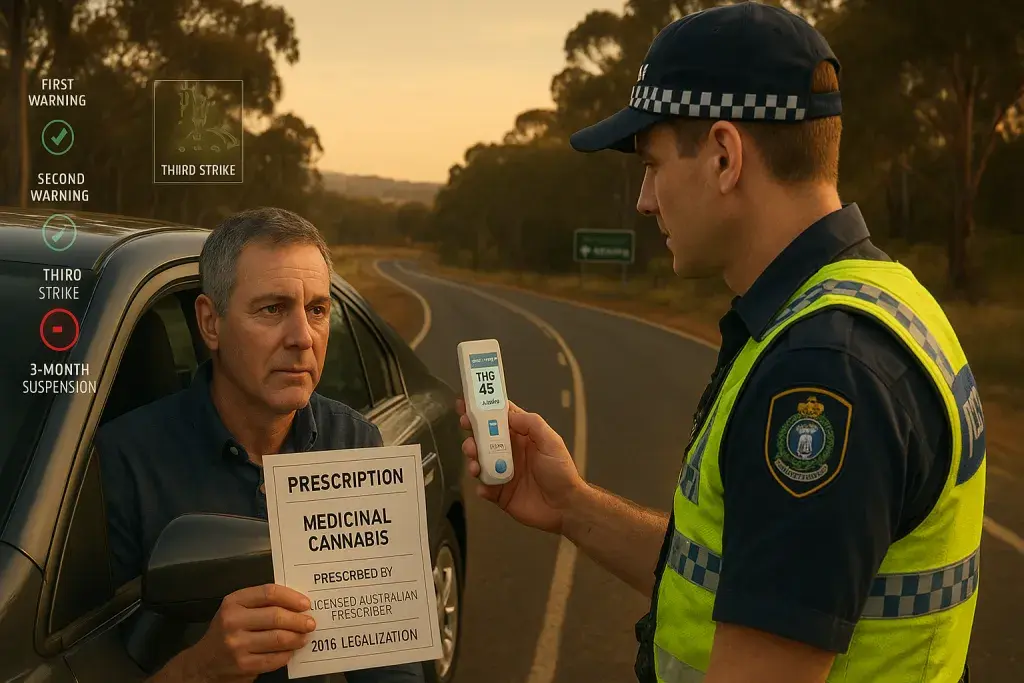
Since medicinal cannabis was legalized in Australia in 2016, patients have occupied an uncomfortable legal position: their prescriptions are lawful, but the act of driving after use - even hours later, even when not impaired - has exposed them to the same enforcement as recreational users. That asymmetry has drawn mounting criticism from patient advocates, particularly those in rural and regional communities where a vehicle is not optional. Losing a licence, under current rules, can mean losing access to work, healthcare, and basic services. The proposed reforms address that reality with a structured, graduated response rather than a flat prohibition.
How the Enforcement Mechanics Actually Work
The structure NSW is proposing is worth examining carefully, because the details carry real compliance weight. Roadside drug testing would continue unchanged - any positive result triggers an immediate 24-hour suspension while a secondary sample goes to a laboratory. That part is not new. What changes is what happens after the lab result comes back.
If THC registers below 50 ng/mL, the driver faces no further action. Above that threshold, a three-strike system applies: the first and second offences within a two-year window result in warnings, giving patients time to adjust dosing schedules and driving habits. A third violation within that period triggers a minimum three-month licence suspension and a fine of AU$704. Patients would also be required to complete a safety course and provide prescription details to Transport for NSW.
That graduated structure is deliberate. It mirrors the kind of tiered compliance thinking regulators in alcohol, pharmaceuticals, and financial services have long used - escalating consequences that create space for correction before full penalties apply. What's striking here is that it also places a documentation burden on patients: prescription records become a functional part of a road safety compliance framework, which has implications for how dispensaries and prescribers communicate with their patient base.
The Science Gap That Critics Keep Pointing To
Not everyone is convinced the 50 ng/mL figure is the right one. Road safety groups, including the NRMA, have raised concerns that cannabis impairment does not behave the way alcohol impairment does. Blood-alcohol concentration tracks fairly predictably with cognitive and motor performance. THC in saliva does not - tolerance levels, consumption frequency, metabolism, and product type all affect the relationship between detected concentration and actual impairment. Associate Professor Michael Fitzharris of Monash University has described the reform as a significant milestone, comparing it to the establishment of blood-alcohol limits as a regulatory framework, but critics argue the analogy has limits precisely because the underlying pharmacology is less linear.
To put it plainly: the science is unsettled, and the NSW government is legislating ahead of a complete evidence base. That is not unprecedented in drug policy - early alcohol limits were also set with imperfect data - but it does mean the 50 ng/mL threshold may face revision as post-implementation research accumulates. Businesses and prescribers operating in this space should treat the specific number as a starting point, not a stable ceiling.
Why This Matters for Cannabis Businesses and Regulators Beyond Australia
If NSW passes these reforms, it becomes the first jurisdiction globally to codify a roadside THC threshold for medicinal users. That is not a minor footnote. Regulators in Canada, the United Kingdom, Germany, and U.S. states with active medical programmes will be watching, because the core problem NSW is trying to solve - how to treat medicinal patients differently from impaired recreational users under road law - is shared by every jurisdiction that has legalized cannabis in any form.
For cannabis businesses, the downstream implications are practical. Dispensaries and patient-facing operators would have new grounds to provide clearer, more specific guidance around product timing, dosage, and driving. Prescribers would likely need to counsel patients on the documentation requirements Transport for NSW would impose. And any operator building compliance programmes - whether in Australia or internationally - would have a concrete regulatory model to reference when arguing for proportionate, evidence-informed rules rather than zero-tolerance approaches that treat every patient as an impairment risk.
The proposal is not a green light for impaired driving. The 24-hour suspension pending lab results remains. The three-strike mechanism has teeth. What NSW is building, cautiously, is a framework that distinguishes between the presence of a substance and the impairment it may or may not cause - a distinction that the cannabis industry has been arguing for since before most markets opened. Whether the science catches up quickly enough to validate the specific threshold is a separate question. But the regulatory model itself is worth watching closely.