
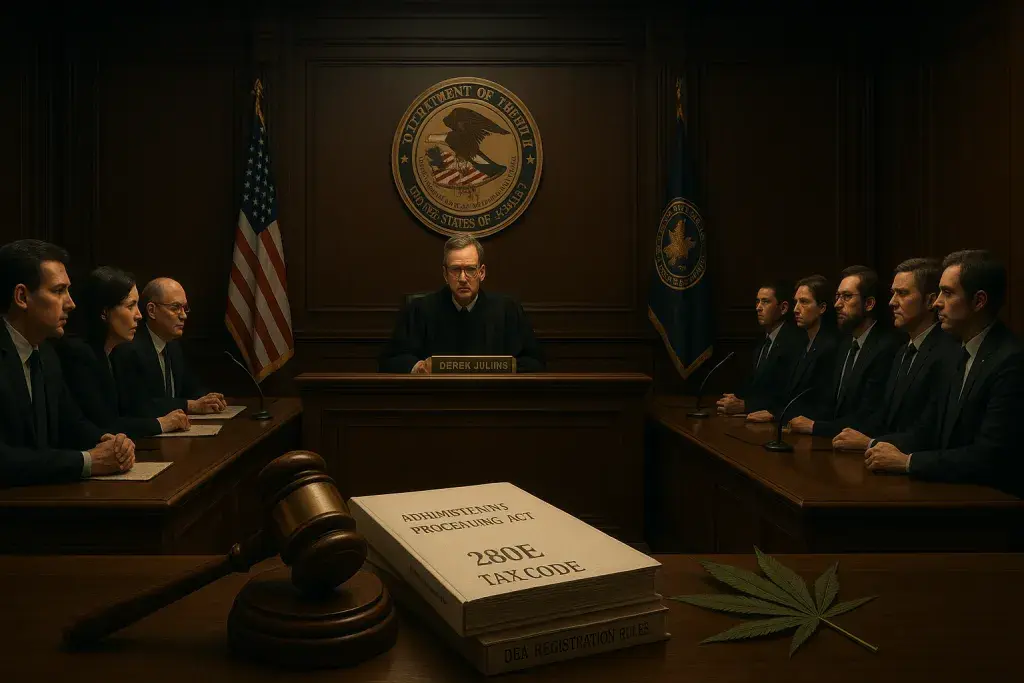
Federal hearings on whether to reclassify marijuana under the Controlled Substances Act opened Monday in the Washington, D.C., area - and neither cannabis operators, industry associations, nor drug-policy reform advocates have a seat at the table. What began as the Biden administration's proposal to move marijuana from Schedule 1 to Schedule 3 is now being argued, for and against, exclusively between the Trump Justice Department and seven anti-cannabis parties selected by the DEA as eligible "interested parties" under the federal Administrative Procedures Act.
For licensed operators - from single-location dispensaries in emerging markets to multi-state operators managing compliance across a dozen state systems - the proceedings carry real weight, even if the outcome is anything but guaranteed. States like Maryland, where operators depend on tightly regulated infrastructure like Maryland seed-to-sale dispensary software to stay compliant under both state and evolving federal frameworks, are watching closely. Any federal rescheduling would trigger downstream effects on taxation, DEA registration, and the legal standing of adult-use sales that state regulators have not yet been given clear guidance on.
The hearings are presided over by DEA Chief Administrative Law Judge Derek Julius, whose June 18 preliminary order defined the scope narrowly: the question before him is whether marijuana, as defined under the CSA, should move from Schedule 1 to Schedule 3. The government - as the party that proposed the rule - carries the burden of proof. Each of the seven participating opponents gets one assigned day, up to two witnesses, and no more than four hours of total testimony. Cross-examination by either side is capped at one hour. Prehearing statements were due Wednesday; evidence exhibits by Thursday.
A Nonbinding Process With Uncertain Ends
Here's the catch: Julius' eventual ruling carries no binding authority. The DEA and Justice Department are free to accept it, disregard it, or let it sit. There is no statutory deadline for Julius to issue a ruling, and no deadline for the DEA to act after receiving one. The hearings are scheduled to conclude July 15, but an order from Julius could follow weeks, months, or not at all - a dynamic that mirrors what happened under the Biden administration, when a prior round of hearings was suspended indefinitely on the eve of Trump's second inauguration and later canceled by Acting Attorney General Todd Blanche.
Julius' range of recommendations is also worth understanding precisely. He can recommend Schedule 3 - consistent with the August 2023 recommendation from the Department of Health and Human Services. He can recommend Schedule 2, a designation that would create serious complications for the existing legal market, or he can recommend marijuana remain on Schedule 1. That's a meaningful spread of outcomes with very different operational implications for every tier of the supply chain.
The hearings are also not open to public broadcast - online or otherwise. That limits transparency at a moment when operators, compliance officers, and state regulators are trying to anticipate the next move.
What Rescheduling Would and Wouldn't Change for Operators
If adult-use marijuana is ultimately rescheduled to Schedule 3, the immediate practical relief many operators are waiting for would not arrive automatically. The 280E tax burden - which prevents cannabis businesses from deducting standard business expenses because they traffic in a Schedule 1 or Schedule 2 substance - would technically no longer apply to Schedule 3 operators under the Internal Revenue Code. But Treasury Department and IRS guidance on how that relief actually works in practice has not been issued, and operators remain in a holding pattern.
DEA registration is another open question. Medical cannabis operators received a pathway to register with the DEA following the April 23 final order rescheduling medical cannabis to Schedule 3. Whether adult-use operators would receive the same treatment under a separate rescheduling order is not settled. State regulators have asked the DEA for clarity on this and related questions; they've received little in return.
The inconsistency between state and federal law would also persist. Even if marijuana becomes Schedule 3 federally, state licensing structures, excise tax frameworks, testing and labeling requirements, and product compliance rules don't automatically align. That means dispensary operators, wholesale distributors, and licensed brands would still be managing two separate regulatory realities - just with a different federal classification attached to the product.
The Exclusion Problem and What It Means for Future Litigation
The industry's exclusion from the proceedings isn't just a frustration - it's a legal exposure. For reform supporters observing from the outside, one primary objective is ensuring the administrative record is clean enough to survive judicial review. If adult-use marijuana is rescheduled and opponents file legal challenges - which, given the track record with medical cannabis rescheduling, is a near-certainty - a federal court could scrutinize the process itself. A flawed or incomplete record becomes a vulnerability.
That concern is not abstract. The DEA's selection of seven opponents and zero proponents as "interested parties" under the APA definition - entities "adversely affected or aggrieved" by the proposed rule - has drawn scrutiny precisely because it leaves the administrative record one-sided. The government argues the case for rescheduling. No licensed operator, no state cannabis regulator acting in a pro-reform capacity, no trade association presents evidence. Whatever Julius ultimately writes, that structural asymmetry follows the record into any subsequent litigation.
To put it plainly: the people with the most to gain or lose from federal rescheduling are spending this week reading about the hearings rather than participating in them. And the eventual outcome - whether that's a Schedule 3 recommendation, a delay, or a legal challenge that unwinds the process entirely - will land on their balance sheets regardless.