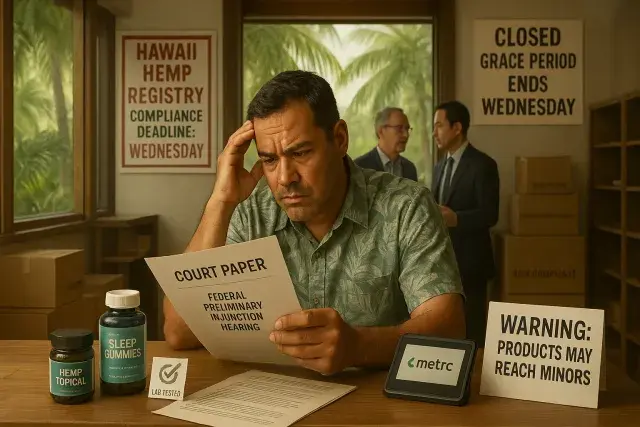
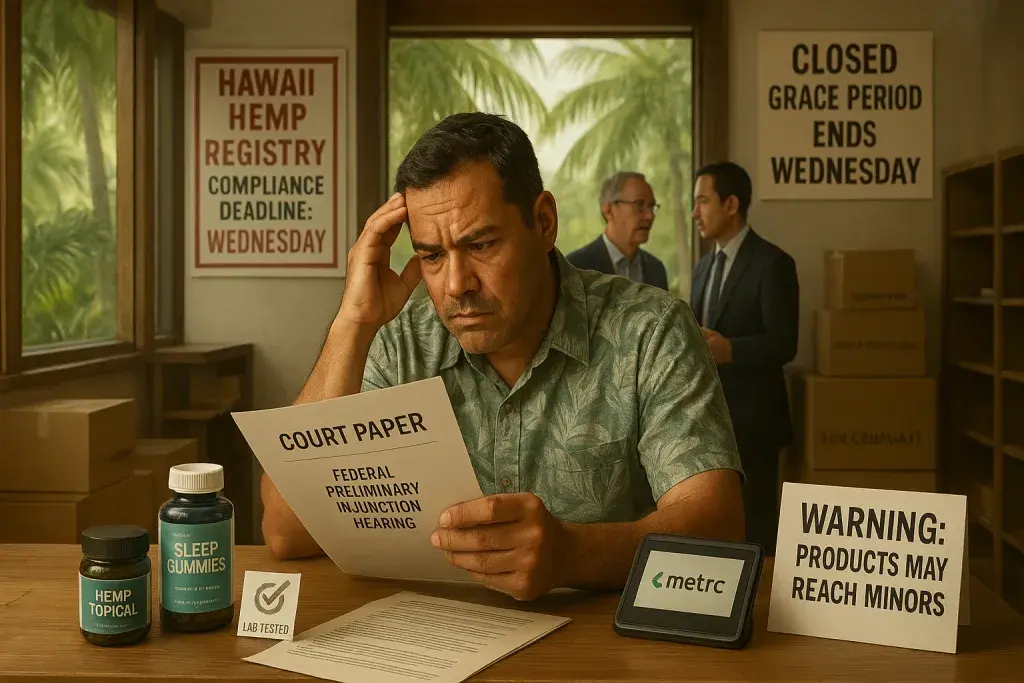
Hawaii's hemp and CBD retail sector faces a hard compliance deadline this week as the state begins enforcing a registration law that took effect January 1. Enforcement had been delayed by a grace period, but that window closed Wednesday - and with only 50 shops registered statewide, the majority of hemp retailers are now exposed to potential action. A federal court hearing scheduled for Thursday could halt enforcement almost immediately, but the regulatory pressure is real, and the business stakes for small operators are steep.
The situation in Hawaii reflects a compliance pattern that licensed cannabis retailers in other regulated states know well: a law passes, a soft launch follows, and then enforcement arrives faster than many operators are prepared for. State-licensed dispensaries operating under seed-to-sale tracking requirements, COA documentation mandates, and strict labeling protocols have long managed this kind of regulatory exposure. Hemp and CBD retailers, historically subject to far lighter oversight, are now being held to a comparable standard - and many weren't ready. For operators elsewhere building compliant retail infrastructure from the ground up, tools like a Metrc-compliant POS for Ohio illustrate the kind of back-end compliance architecture that regulated markets increasingly demand, whether the product is medical cannabis, adult-use flower, or hemp-derived goods.
What the Law Actually Requires
The statute defines a narrow category of legally sellable goods: "manufactured hemp products" that meet Hawaii's full regulatory requirements. That means compliant lab testing, child-safety packaging, proper labeling, and - critically - THC limits capped at 1 milligram per serving and 5 milligrams per package. Edibles, topicals, and beverages can qualify under that definition. Vapes, smokeable hemp, and products derived from synthetic or artificially converted cannabinoids - including those synthesized from CBD - cannot.
That last restriction is the one cutting deepest. The hemp market over the past several years has been flooded with products containing delta-8 THC, delta-10 THC, HHC, and other cannabinoids created through chemical conversion of CBD. Those products exist in a legal gray zone federally and have been explicitly legal in many states - but Hawaii is drawing a hard line. State Medical Cannabis Control director Andrew Goff put it plainly: "Products like smokables, vapes, those have never been legal under Hawaii law." For retailers whose SKU mix skews heavily toward those categories, this isn't a paperwork problem. It's an inventory crisis.
The Business Reality for Small Operators
Lance Alyas, a plaintiff in the federal lawsuit seeking a preliminary injunction and the owner of four hemp and CBD shops, described stripping nearly 90 percent of his product line to comply. He said his remaining inventory - flower, sleep gummies, smokables - would be swept off shelves under the law's current interpretation. "It will probably destroy our business," he said. That's not hyperbole in the context of small-format specialty retail. A shop built around a particular product category - hemp vapes, delta-8 edibles, CBD smokables - doesn't have the margin structure or inventory depth to pivot on short notice.
Here's the catch: Goff's counter-argument isn't unreasonable on its face. The law passed last year. Enforcement was deferred. "You had time to change your inventory or pivot from whatever industry you want to go into," he said. In a licensed dispensary context, regulators make similar arguments when operators miss compliance windows on packaging updates, testing requirements, or METRC reconciliation deadlines. Ignorance of the timeline rarely qualifies as a defense. But the hemp market is structurally different - it attracted small entrepreneurs operating under the assumption that federal hemp legality provided meaningful cover, and the patchwork of state-level restrictions didn't always communicate otherwise.
A Federal Court Could Pause Everything by Thursday
The plaintiffs are asking for a preliminary injunction - a procedural mechanism that asks a judge to pause enforcement while the underlying legal arguments are litigated. The standard for winning a preliminary injunction is meaningful: petitioners typically must show a likelihood of success on the merits, irreparable harm without relief, and that the balance of equities favors a pause. Whether the court finds those conditions met on Thursday is an open question, but the injunction request alone signals that the retailers believe they have a substantive legal argument, not just a timing complaint.
State politicians aren't softening the position. Rep. Scot Matayoshi, chair of the House Consumer Protection Committee, said plainly that if enforcing the law puts non-compliant retailers out of business, that outcome is acceptable - particularly given concerns about products reaching minors and circumventing existing cannabis regulations. That's a consumer-safety and age-access argument with real weight in any regulated retail environment. The debate over synthetic cannabinoids and high-potency hemp products has centered on exactly this issue in several states: products that are technically hemp-derived but functionally intoxicating, sold in retail environments without the age-verification protocols or compliance infrastructure that licensed cannabis dispensaries are required to maintain.
Whatever the federal judge decides Thursday, the Hawaii situation is a signal worth reading carefully. As states move to close the regulatory gap between licensed cannabis retail and the unregulated hemp market, compliance costs will climb - and operators without the systems, inventory controls, and documentation practices to meet those standards will face exactly this kind of pressure.