
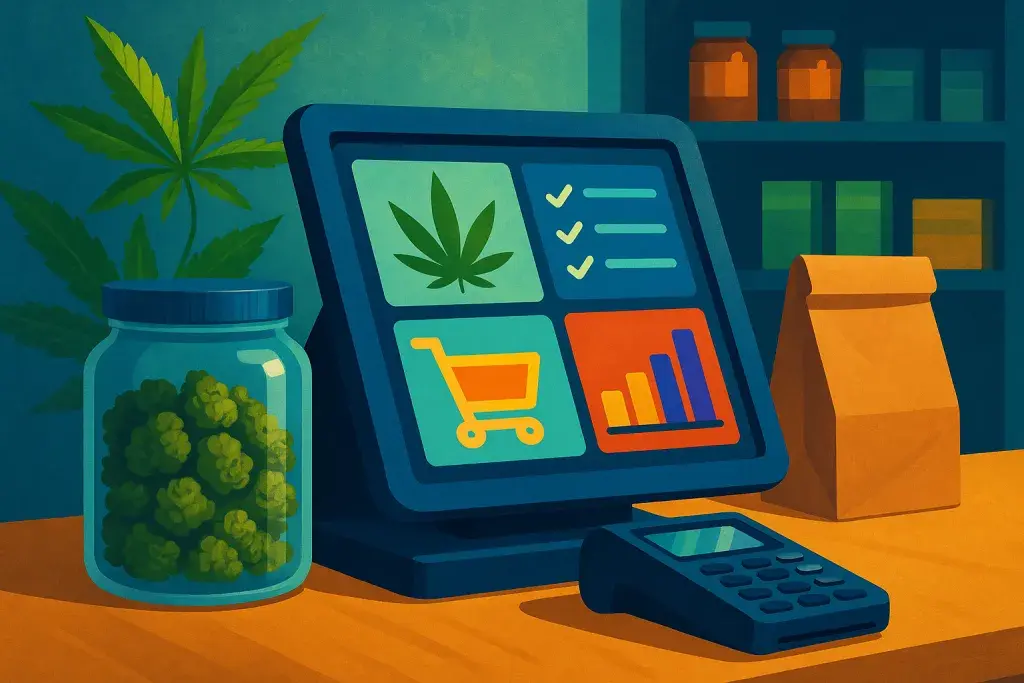
Running a cannabis dispensary is one of the few retail operations where a single inventory error can trigger a state audit, and a missed compliance filing can result in license suspension. The margin for operational error is genuinely thin. Yet many dispensaries still patch together disconnected tools - a basic cash register, a spreadsheet for stock, and a manual customer log - while wondering why their margins stay tight and their staff stays stressed. The answer is rarely about effort. It is about infrastructure.
The shift toward integrated technology has changed what is possible for cannabis retailers. A purpose-built dispensary POS system no longer just processes transactions - it connects every operational layer, from seed-to-sale tracking to customer retention. When point-of-sale technology is combined with dispensary management software that handles inventory, compliance, retail workflows, and customer relationships in one environment, the operational difference is substantial. Dispensaries that make this shift tend to resolve problems they did not even know were costing them money.
This article walks through each functional layer of that integrated system - what it does, why it matters, and how it changes daily operations for cannabis retailers who are serious about growing a sustainable business.
The Foundation: What a Dispensary POS System Actually Does
Beyond the Transaction: The POS as an Operational Hub
Most people think of a point-of-sale system as the device that takes payment. In cannabis retail, that framing undersells what the technology actually does. A well-built dispensary POS system is the connective layer between your customers, your inventory, your compliance obligations, and your business data. Every sale generates information - about what sold, at what price, to which customer, at what time of day - and a purpose-built POS captures all of it in real time.
In general retail, losing that data is inconvenient. In cannabis retail, it creates compliance gaps. State and local regulatory bodies require that every transaction be traceable. When the POS integrates directly with state-mandated tracking systems, that traceability happens automatically rather than through manual entry at the end of a shift. That distinction alone saves hours per week and eliminates a category of human error that regularly trips up dispensaries during audits.
Hardware Considerations That Affect Workflow
The physical setup of a dispensary POS affects how efficiently your staff can serve customers. Tablet-based systems allow budtenders to assist customers on the floor rather than anchoring them behind a counter. Integrated receipt printers, cash drawers, and ID scanners reduce the number of steps per transaction. Barcode scanning tied to inventory updates means that the moment a product is sold, stock levels adjust without any additional input.
Speed matters here more than it might seem. During peak hours, transaction time directly influences customer throughput. A system that requires three extra taps or a manual product lookup costs seconds per sale - and those seconds compound quickly on a busy Friday evening.
Integration as a Design Requirement, Not a Feature
A dispensary POS system that cannot talk to your inventory software, your compliance reporting tools, or your customer database is not really a hub - it is just a faster cash register. The value of the POS multiplies when it shares data with every other operational system in real time. Choosing a POS that treats integration as optional or requires expensive middleware should be a disqualifying factor during vendor evaluation.
Cannabis Inventory Management Software: Precision Where It Counts
Why Cannabis Inventory Is Uniquely Complex
Cannabis inventory is not like retail apparel or consumer electronics. Products are regulated substances with legally mandated tracking requirements that follow each unit from cultivation through final sale. Weight matters. Batch numbers matter. Expiration windows matter. A dispensary carrying dozens of SKUs across flower, concentrates, edibles, and topicals is managing a product catalog where the consequences of a discrepancy extend well beyond shrinkage into regulatory territory.
Cannabis inventory management software built specifically for this industry handles that complexity in ways that a general retail inventory tool cannot. It integrates with state traceability platforms, automatically adjusts quantities at the point of sale, flags low-stock conditions before they become outages, and maintains a full audit trail for every product movement within the store.
Real-Time Tracking and Shrinkage Control
One of the most practical benefits of purpose-built cannabis inventory management software is real-time visibility. When a budtender scans a product at checkout, inventory decrements instantly. When a return is processed, it logs back with the appropriate status. When a product fails quality review and is removed from sale, that event is recorded with a reason code. At any moment, a manager can see exactly what is on the shelves without conducting a manual count.
This real-time picture also makes shrinkage - whether from theft, mislabeling, or processing errors - much easier to detect and investigate. Discrepancies show up immediately rather than surfacing during a quarterly audit when the trail has gone cold.
Supplier Management and Purchasing Efficiency
Good cannabis inventory management software does not just track what is in the store - it helps managers make better purchasing decisions. By analyzing sales velocity by product category, strain, format, and price point, the system surfaces which products move quickly and which sit on shelves. Reorder thresholds can be set automatically, and purchase orders can be generated directly within the platform. This reduces over-ordering of slow-moving inventory while preventing stockouts on top sellers - a balance that directly impacts both cash flow and customer satisfaction.
Dispensary Compliance Software: Staying Legal Without Constant Manual Work
The Compliance Burden in Cannabis Retail
Cannabis dispensaries operate under a regulatory framework that has no real equivalent in other retail sectors. State traceability requirements, purchase limits per customer, age verification mandates, metrc reporting obligations, and product testing documentation are all part of normal operations. Missing a single reporting window or allowing a transaction that exceeds legal purchase limits can have serious consequences - from fines to license action.
Manual compliance management at this scale is not just inefficient - it is genuinely risky. Staff making compliance judgments at the point of sale under time pressure will eventually make errors. Dispensary compliance software removes the reliance on individual judgment for rule-based decisions by enforcing them automatically at the system level.
Automated Reporting and Regulatory Integrations
The most time-consuming compliance task for most dispensaries is reporting to state regulatory systems. Dispensary compliance software that integrates directly with platforms like Metrc transmits sale data, inventory adjustments, and package movements automatically. Instead of manual data entry at the end of every business day, the system handles submissions in the background.
This automation reduces reporting errors, eliminates duplicate data entry, and ensures that state records match internal records in real time. When a regulatory body requests records, the data is organized, current, and exportable rather than scattered across spreadsheets and handwritten logs.
Purchase Limit Enforcement and ID Verification
Customer-facing compliance - enforcing purchase limits and verifying legal age - is where errors create direct regulatory exposure. Dispensary compliance software handles both at the transaction level. ID scanning at check-in feeds into the system, which logs the customer's verified age for the session. As a transaction is built, the system tracks cumulative purchase weight against applicable legal limits and blocks or alerts the budtender before a violation occurs.
This is not a fallback - it is a primary control. Relying on a budtender to mentally track whether a customer has already purchased flower elsewhere that day is an unrealistic expectation. The software handles it consistently, regardless of how busy the floor is.
Marijuana Retail Management System: Running the Store With Real Clarity
Staff Management and Role-Based Access
A complete marijuana retail management system gives dispensary operators control over who can do what within the platform. Role-based access ensures that a budtender can process sales and check inventory but cannot override a compliance flag or access sensitive financial reports. Managers get broader access. Owners see everything. This structure reduces exposure to internal theft and errors while keeping the interface clean and relevant for each user type.
Staff performance tracking is another practical component. Managers can review individual sales metrics, identify training gaps, and compare performance across shifts or locations without pulling reports from multiple systems. That visibility supports better scheduling decisions and more targeted staff development.
Multi-Location Operations and Centralized Control
Dispensary groups operating more than one location face operational complexity that single-store systems cannot handle well. A marijuana retail management system designed for multi-location operations maintains centralized inventory visibility, standardized pricing across locations, unified compliance reporting, and consolidated financial data - all accessible from a single administrative interface.
Without that centralized view, a regional manager or owner is relying on manually compiled reports from individual stores that are already out of date by the time they arrive. Real-time, location-level data changes how quickly operational problems get identified and addressed.
Reporting and Business Intelligence
Data is only useful if it is accessible in a form that drives decisions. A strong marijuana retail management system surfaces the metrics that matter - daily revenue, average transaction value, product category performance, peak traffic hours, return rates, and margin by SKU - through dashboards that do not require a data analyst to interpret. Managers can spot trends, identify underperformers, and act on the information without waiting for a monthly report to be assembled.
Dispensary CRM Software: Building Customer Relationships That Drive Repeat Revenue
Why Cannabis Customer Data Is an Asset
Dispensaries collect meaningful customer data with every transaction - purchase history, product preferences, visit frequency, average spend - but most of that data sits unused in a database unless the operation has tools designed to activate it. Dispensary CRM software turns transaction records into actionable customer intelligence that supports marketing, loyalty programs, and personalized service.
In a market where most customers have multiple dispensary options within driving distance, the relationship between a store and its regulars is a real competitive factor. A customer who feels recognized and receives relevant communications is less likely to try a competitor's new opening. That retention has direct revenue implications.
Loyalty Programs and Incentive Structures
A well-configured dispensary CRM software enables loyalty programs that reward purchase frequency, spending thresholds, product exploration, or referrals. Points systems, tiered membership levels, and birthday rewards are all mechanisms that increase visit frequency and average order size when implemented correctly.
The key is that the rewards feel personal and relevant rather than generic. A customer who primarily buys high-end concentrates does not need a coupon for entry-level flower. CRM software that segments customers by behavior allows targeted offers that are genuinely useful - and therefore more likely to be redeemed and appreciated.
Marketing Automation and Customer Segmentation
Dispensary CRM software also powers outbound communication - SMS campaigns, email newsletters, and targeted promotions - in ways that comply with cannabis marketing regulations. By segmenting the customer base by purchase history, visit recency, and product category preference, marketing messages can be targeted precisely rather than broadcast uniformly.
A customer who has not visited in 60 days gets a re-engagement offer. A frequent customer approaching a loyalty tier threshold gets a personalized nudge. A new customer who bought edibles on their first visit gets follow-up content about complementary products. These are not sophisticated hypotheticals - they are standard capabilities of a well-implemented CRM, and they consistently outperform untargeted promotions in terms of redemption and revenue impact.
How the Integrated System Creates Operational Synergy
When All Four Layers Work Together
The individual value of each component - the dispensary POS system, cannabis inventory management software, dispensary compliance software, and dispensary CRM software - is real but limited when any one layer operates in isolation. The compounding benefit comes from integration. When a sale is processed at the POS, it simultaneously decrements inventory, updates compliance records, transmits to state regulatory systems, credits a loyalty account, and feeds into customer purchase history. That happens in a single transaction event, not through four separate manual processes.
The result is a store that generates its own documentation, tracks its own compliance, and builds its own customer intelligence as a natural byproduct of normal operations. Staff spend less time on administrative tasks and more time on customer service. Managers spend less time chasing data and more time acting on it.
Reducing Error Chains in High-Stakes Environments
In any operation where multiple manual steps connect processes, each handoff is a potential error point. Cannabis retail has more of those handoffs than most industries - between receiving inventory, logging it in the system, displaying it for sale, selling it, and reporting it to regulators. A disconnected technology stack means that data must be re-entered or transferred at each step, multiplying the chance of discrepancy.
An integrated marijuana retail management system eliminates most of those handoffs. Data entered once at receiving flows through the entire operation. The downstream consequences of that error reduction - fewer audit findings, fewer stock discrepancies, fewer compliance flags - are significant in aggregate.
Scalability and Growth Infrastructure
A dispensary that outgrows its technology stack faces a painful transition at exactly the moment when operational complexity is highest. Building on an integrated platform from the beginning - or migrating to one before scaling - means that adding a second location, expanding product lines, or growing staff does not require rebuilding operational processes from scratch. The infrastructure grows with the business rather than becoming a ceiling on it.
Choosing the Right Platform: What to Evaluate
Industry Specificity Over General-Purpose Tools
A general retail POS adapted for cannabis use will always lag behind a platform built for cannabis from the ground up. The difference shows up in compliance integrations, seed-to-sale tracking accuracy, and the granularity of inventory categorization. Dispensaries evaluating technology platforms should prioritize vendors whose entire product focus is cannabis retail rather than those treating it as a vertical within a broader offering.
Support, Training, and Implementation Quality
Even the best-designed system will underperform if staff are not trained to use it effectively. Vendor support quality - response time, training resources, availability during business hours and peak seasons - is a legitimate evaluation criterion that often gets underweighted during purchasing decisions. References from existing customers about post-implementation experience are more reliable than sales demonstrations.
Total Cost of Ownership
Pricing structures in this space vary widely - monthly SaaS fees, per-transaction charges, hardware costs, and add-on module pricing. Evaluating the total cost of ownership over a two-to-three-year period, including implementation, training, and integrations, gives a more accurate comparison than headline subscription pricing. A cheaper platform that requires manual workarounds for compliance reporting may cost more in staff time than a more expensive fully integrated solution.
- Confirm that state traceability integrations are included, not sold as add-ons
- Verify that CRM and loyalty features are native or deeply integrated, not bolted on
- Ask specifically about multi-location support if expansion is part of the plan
- Evaluate data export capabilities - you should own your data and be able to move it
- Check uptime guarantees and contingency protocols for system outages during business hours
Frequently Asked Questions
Can a dispensary POS system connect directly to state traceability platforms like Metrc?
Yes, and this is one of the most important features to verify before choosing a platform. A POS system with a native Metrc integration transmits inventory movements and sales data automatically, which eliminates the manual reporting step entirely. Not all systems offer this natively - some require third-party middleware that adds cost and creates additional potential failure points.
What happens to inventory accuracy when a product is returned or transferred between locations?
Cannabis inventory management software handles returns and inter-location transfers as distinct transaction types, each with its own audit trail. A returned product is logged back into available inventory with its batch information intact, and a transfer between locations creates a manifest record in the system that satisfies regulatory requirements. Accuracy depends on staff following the correct procedure within the software, which is why training at implementation matters.
How does dispensary compliance software handle purchase limits for medical versus recreational customers?
The software stores customer type - medical or recreational - as part of the verified customer profile and applies the corresponding purchase limit rules automatically during checkout. When a transaction would exceed the applicable limit, the system alerts the budtender or blocks the transaction depending on configuration. This works in real time, which is more reliable than relying on staff to perform that calculation manually under pressure.
Is dispensary CRM software subject to cannabis marketing regulations, and how does the software help with that?
Yes, cannabis marketing is heavily regulated in most jurisdictions, with restrictions on where and how dispensaries can advertise to customers. Dispensary CRM platforms built for the cannabis industry typically include compliance guardrails - for example, requiring age verification consent before adding customers to marketing lists and providing tools to exclude customers in jurisdictions with stricter rules. The software cannot replace legal counsel on marketing compliance, but it does provide a structure that reduces exposure.
How long does implementation typically take for a fully integrated dispensary management platform?
For a single-location dispensary moving from disconnected tools to a fully integrated platform, implementation typically takes between two and six weeks, depending on data migration complexity and staff training requirements. Multi-location operations or those migrating large customer databases may take longer. Most vendors offer phased implementations that allow the store to continue operating during the transition.
Can a marijuana retail management system support different pricing for members, medical patients, and general retail customers?
Yes, tiered pricing is a standard capability in purpose-built marijuana retail management systems. Pricing rules can be configured by customer group, product category, time of day, or promotional period. At checkout, the system applies the correct pricing automatically based on the customer's verified profile, which reduces manual adjustments and the pricing errors that come with them.