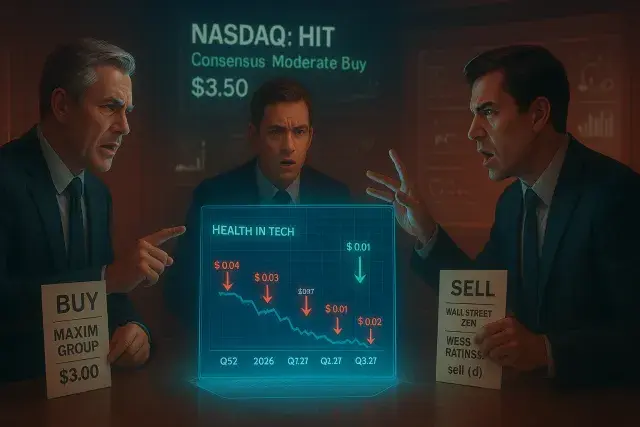
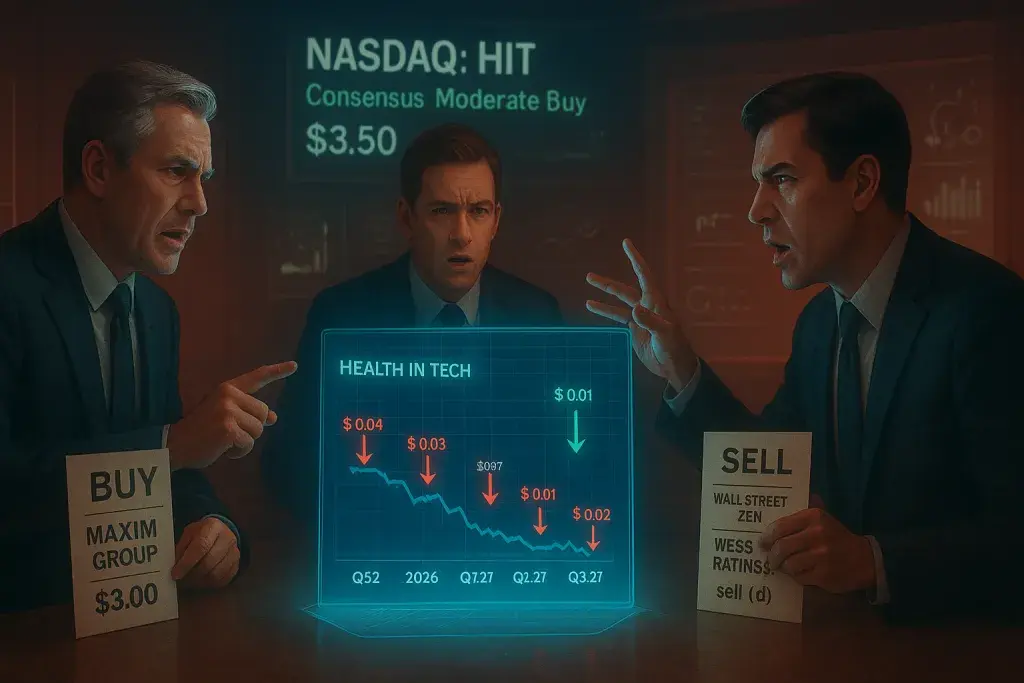
Health In Tech, Inc. (NASDAQ: HIT) is drawing a mixed but active read from Wall Street this month, with Maxim Group publishing a fresh round of quarterly EPS projections that stretch well into 2027. The estimates, issued August 14th by analyst A. Klee, point to continued losses at the small-cap health insurance technology firm through at least the first half of next year, with a narrow path to breakeven appearing only in isolated quarters. That's a notable signal for a company whose stock has attracted three distinct analyst calls in recent months - ranging from bullish to bearish - leaving investors with genuinely divergent views on where the business is headed.
For context, Health In Tech operates in the health insurance technology space rather than cannabis retail or plant-touching commerce, though the underlying dynamics of thinly covered small-cap stocks tracking toward profitability will feel familiar to anyone who follows emerging regulated industries. Just as cannabis operators lean on platforms like metrc integration maine to reconcile compliance data across state reporting systems, health-tech firms depend on integrated back-end infrastructure to scale distribution while managing regulatory overhead. The comparison is instructive: both sectors face capital-intensive build-outs, licensing or certification hurdles, and investor bases that demand clarity on when losses give way to sustained earnings. metrc integration maine
Maxim's numbers lay out a bumpy road. The firm projects a per-share loss of $0.04 for Q3 2026, narrowing slightly to a $0.03 loss in Q4 2026, with full-year 2026 losses estimated at $0.10 per share. Looking further out, Maxim sees a brief flicker of profitability in Q1 2027 at $0.01 per share, followed by a $0.01 loss in Q2 2027, a flat result in Q3 2027, and a return to a $0.02 loss in Q4 2027 - bringing full-year 2027 estimates to a $0.02 loss per share. In practice, though, this kind of quarter-to-quarter oscillation between marginal gains and losses is typical of early-stage technology firms still working out unit economics, and it tells investors the company hasn't yet reached a point of durable operating leverage.
Analyst Sentiment Is Genuinely Divided
Here's the catch: not every research shop sees the same trajectory. Maxim Group holds a "Buy" rating with a $3.00 price target, while Craig Hallum initiated coverage with its own "Buy" call and a more aggressive $4.00 target. Wall Street Zen, on the other hand, downgraded the stock from "hold" to "sell" in late April, and Weiss Ratings has kept a "sell (d)" designation on the name as recently as June. That spread - one Strong Buy, one Buy, one Sell - has produced a consensus "Moderate Buy" rating with an average price target of $3.50, according to MarketBeat.com aggregation. Fair enough to note that consensus ratings can smooth over real disagreement; in this case, the underlying analyst notes reveal a split verdict on whether Health In Tech's growth story justifies its current valuation.
What the Estimates Actually Signal
To put it plainly, a company projecting losses across nearly every quarter through 2027, with only intermittent profitability, is still in build-out mode. For investors, that means valuation hinges less on current earnings and more on trajectory - subscriber growth, contract wins, and cost discipline matter more than any single quarter's per-share figure. What's striking here is how closely the rating dispersion tracks that uncertainty: bullish analysts are betting on the company reaching scale before capital runs thin, while bearish ones appear skeptical the path to consistent profit is close enough to justify the stock's current multiple. Neither position is unreasonable given the data on hand.