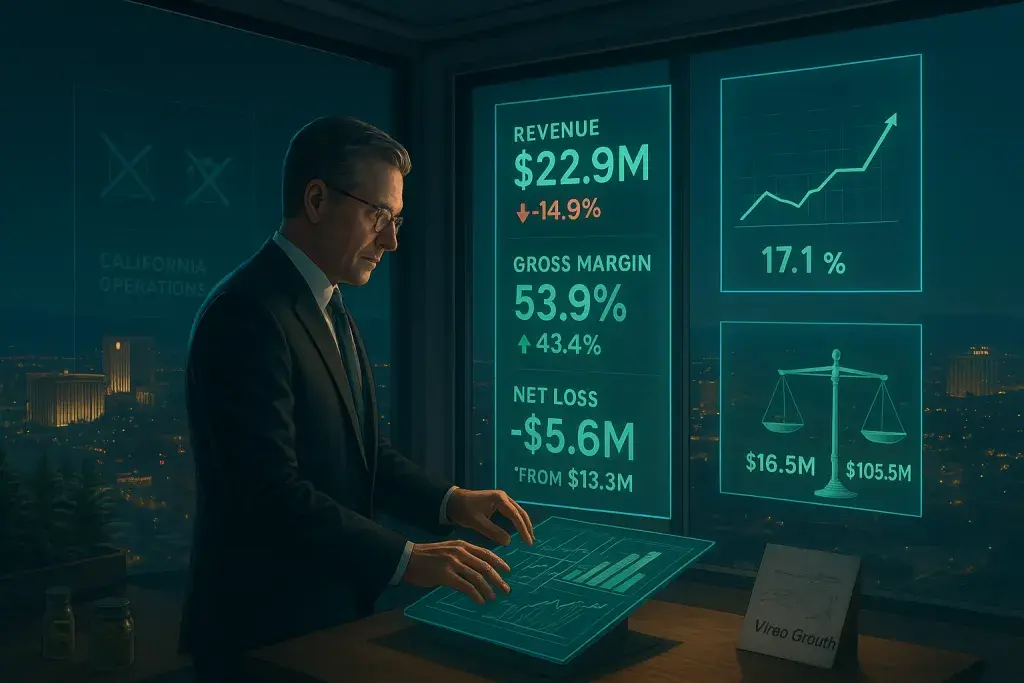
Planet 13 Holdings reported second-quarter 2026 revenue of $22.9 million, down 14.9% from a year earlier, but the multi-state operator's real story sits in the margin line, not the top line. Gross margin climbed to 53.9% from 43.4%, and the net loss narrowed to $5.6 million from $13.3 million, as the Las Vegas-based company works through a California exit and prepares to fold into Vireo Growth under a previously announced merger agreement.
Retrenchment as Strategy
The numbers reflect a company that got smaller on purpose. Planet 13 pulled out of California retail and wholesale operations, a market that has punished operators for years with oversupply, illicit competition, and razor-thin wholesale pricing. Exiting cost the company revenue, but it also removed a drag on gross margin. Total expenses fell 17.7% to $15.2 million, the product of cost-cutting and procurement initiatives that touch everything from cultivation inputs to SKU management. Adjusted EBITDA loss shrank to $0.5 million from $2.4 million - still red ink, but a fraction of what it was. For multi-state operators watching peers retreat from saturated markets, the lesson here is not subtle: scale without discipline is not a strategy, and shedding a money-losing footprint can improve the picture even when headline revenue drops.
Florida's Distillate Overhang Eases
Florida revenue rose 17.1% quarter over quarter, and the company pointed to a $1.0 million reduction in its inventory reserve for Florida distillate as increased sales worked down excess product on hand. Strip out that reserve adjustment and gross margin was 49.5% rather than the reported 53.9% - a detail worth flagging, since inventory reserve releases are a one-time accounting benefit, not a repeatable margin driver. Excess distillate inventory is a familiar headache in vertically integrated markets where cultivation and extraction capacity can outrun retail demand; carrying that inventory ties up capital and invites write-downs. The company also received OMMU approval in May for a Florida BHO extraction facility, and it disclosed a planned Sarasota store, both signs it intends to keep building in Florida even as it consolidates elsewhere.
Balance Sheet Pressure and the Path to Vireo
Cash and restricted cash stood at $16.5 million against total liabilities of $105.5 million, up from $101.2 million at year-end 2025. That gap matters. Cannabis operators still can't access federal bankruptcy protections or normal banking relationships in the way other retailers can, and Section 280E of the federal tax code continues to strip away deductions that any other business would take for granted. Against that backdrop, Co-CEO Bob Groesbeck framed the pending merger with Vireo Growth plainly: the market rewards scale, purchasing power, and a balance sheet that can absorb continued price compression. That's a candid admission. Standalone operators in Nevada and Florida are competing against wholesale pricing pressure that shows no sign of easing, and a combined entity can spread fixed costs, cultivation capacity, and distribution infrastructure across a larger base.
What Operators Should Watch
Planet 13 will not hold a conference call for the quarter, a direct consequence of the pending deal and a reminder that merger timelines tend to quiet routine investor communication. For dispensary operators, wholesalers, and investors tracking the multi-state landscape, the filing offers a case study in how margin recovery and revenue contraction can coexist - and how a definitive merger agreement reshapes what a quarterly report is even meant to communicate.
- Revenue decline driven by California exit and price compression in Nevada and Florida
- Gross margin improvement partly attributable to a one-time inventory reserve adjustment
- Rising total liabilities against modest cash reserves ahead of merger closing
- Continued Florida expansion, including new extraction licensing and store openings, even amid consolidation elsewhere