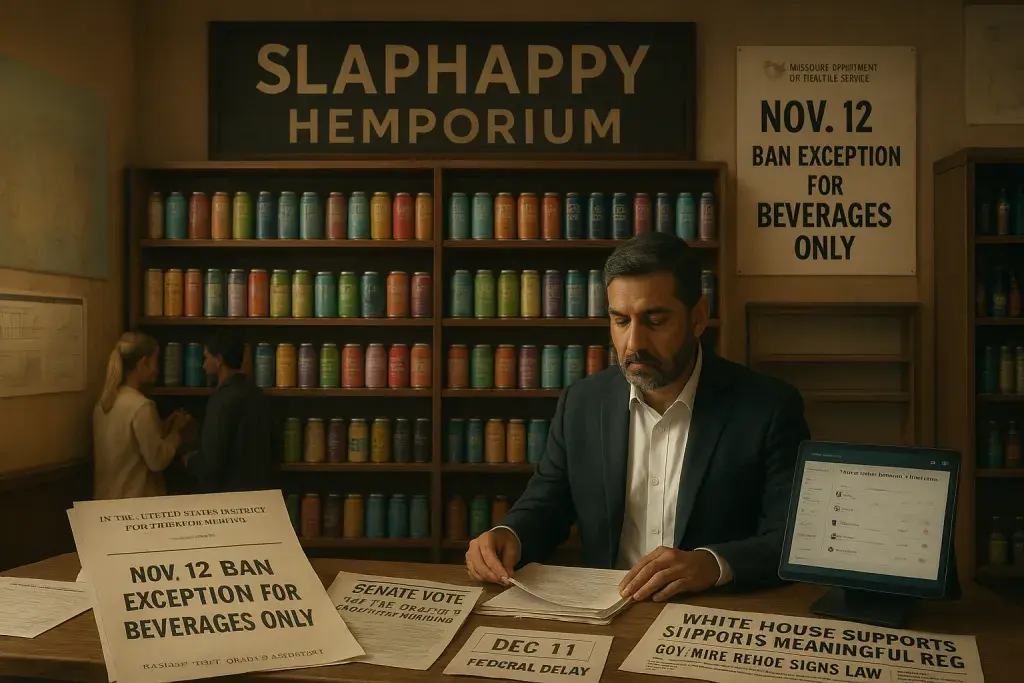
Missouri retailers selling hemp-derived THC beverages got a reprieve, at least on paper, when the U.S. Senate approved a short-term funding measure early Saturday that would push the federal ban on intoxicating hemp products to Dec. 11. The bill still needs House approval and a presidential signature, but if it clears both, Missouri's own Nov. 12 ban on intoxicating hemp products would carve out an exception for beverages specifically - leaving edibles, tinctures, and other hemp-derived THC products off shelves regardless of what Congress does.
For dispensary operators and hemp retailers navigating two sets of rules at once, this is the kind of regulatory whiplash that makes inventory planning genuinely difficult. Compliant packaging, batch testing, and COA documentation all have to shift depending on which product category survives the deadline, and that's before anyone accounts for POS reprogramming to flag SKUs by regulatory status. Multi-category retailers in border states are watching closely, too - a shop running a Tennessee dispensary POS platform, for instance, faces its own patchwork of hemp and marijuana product rules that rarely line up neatly with Missouri's timeline, which only adds to the operational headache of managing compliant menus across state lines. Tennessee dispensary POS platform
Jay Patel, president of the Missouri Hemp Trade Association, called the 61-31 Senate vote a "good sign" for the industry but was careful not to oversell it. "There's a lot of support from the White House actually to get some sort of regulation passed that's meaningful," he said. "Whatever happens on the federal side, it's not going to fully solve our problems in Missouri." That's the blunt truth operators need to sit with: a federal delay buys time, it doesn't buy certainty, and Missouri's underlying state law - the one Gov. Mike Kehoe signed this spring - still bans everything except beverages once the calendar hits Nov. 12, delay or no delay.
A Narrow Exception With Wide Consequences
The carve-out for beverages is oddly specific, and that specificity is exactly the problem for shop owners who built a business around more than seltzers. John Grady, who owns Slaphappy Hemporium with his wife Kara in Rosebud, put it plainly: "We started off as a beverage producer, so for us, that is a good thing, but it also hurts the whole other part of our business." Customers are already stocking up on edibles and other items that face removal from shelves no matter what happens in Washington. That's a rational response from consumers, but it's a rough signal for retailers trying to manage wholesale menus, SKU rationalization, and shrinkage in the weeks before a hard compliance deadline.
Litigation as a Parallel Track
The Missouri Hemp Trade Association and a coalition of hemp businesses aren't waiting on Congress alone. Last month they filed suit in the U.S. District Court for the Western District, arguing the state's new law relies on "unconstitutionally vague" definitions separating hemp from marijuana. Vague statutory language is a real compliance risk, not just a legal technicality - it leaves retailers guessing about which products trigger seed-to-sale tracking obligations, which testing thresholds apply, and where liability sits if a batch is later reclassified. For operators, that ambiguity is arguably a bigger near-term threat than the ban itself.
What Operators Should Watch Next
- Whether the House passes the funding measure with the hemp delay intact, and whether the president signs it before Nov. 12
- Whether Missouri's beverage-only exception holds if the federal delay becomes law, or whether state lawmakers revisit the carve-out
- The outcome of the federal lawsuit challenging Missouri's hemp and marijuana definitions
- Whether Dec. 11 becomes a firmer deadline for comprehensive federal hemp regulation, as groups like the Gradys' are pushing for
None of this offers retailers a stable footing. What it offers is a short runway - through December, if things break the industry's way - to keep some beverage inventory moving while everything else gets pulled from Missouri shelves. For an industry that has spent years operating in a regulatory gray zone, that's not resolution. It's just a later deadline.