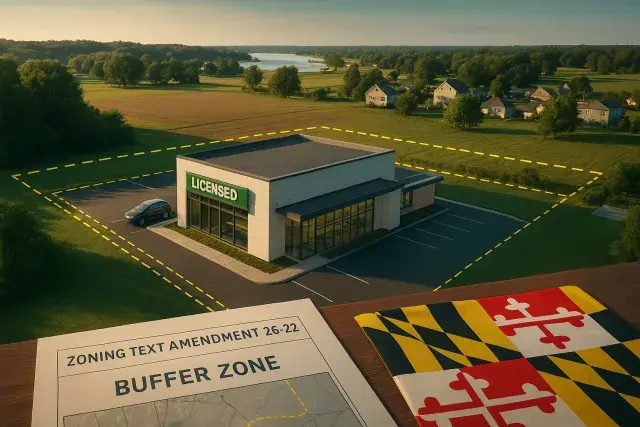
Calvert County, Maryland is pushing forward a zoning text amendment that would require cannabis dispensaries to sit at least 100 feet from residential, rural, waterfront, and agricultural districts - the maximum additional buffer local governments are permitted to impose under state law. The Planning Commission voted at its June 17 public hearing to recommend adoption of Text Amendment 26-22, sending it to the Board of County Commissioners, which holds final authority over zoning text changes. For licensed operators already in the market or scouting real estate in the county, the proposal adds a concrete site-selection constraint that didn't exist before.
The amendment covers more than the building footprint. Parking areas and other infrastructure supporting the dispensary use would also need to fall within the setback boundary - a detail that matters more than it might first appear. In dense or semi-rural commercial zones, where lots are often irregularly shaped or share access lanes, a 100-foot buffer that includes parking can effectively eliminate sites that would otherwise appear compliant on paper. Operators evaluating locations in Calvert County will need to map that full footprint against the proposed setback before making any real estate commitment. This kind of granular site-planning discipline is already standard in states with more mature regulatory frameworks - in Colorado, for instance, operators routinely pair detailed location analysis with tools like a Metrc-compliant POS for Colorado to manage compliance documentation from the ground up, long before a store opens.
What the County Can - and Cannot - Require
Here's the thing about Maryland's local zoning authority over cannabis: it's deliberately bounded. State law limits what additional requirements a county can layer on top of state-level rules, and the 100-foot setback is explicitly the ceiling, not a starting point. County staff told the Planning Commission that this is effectively the only additional zoning requirement Calvert County can impose above what state law already mandates. State law already requires dispensaries to maintain separation from schools and certain other sensitive uses; those requirements apply with or without being echoed in county ordinance.
That's a narrower toolkit than many local governments in other states possess. Some jurisdictions have used extensive conditional-use permitting, hours-of-operation restrictions, signage caps, and density limits to shape where and how dispensaries operate. Calvert County is working within a tighter frame - which means the 100-foot setback carries outsized weight as essentially the one local lever available.
A Standard That Doesn't Apply to Alcohol Retail
A commissioner raised the obvious question during the hearing: do beer, wine, or liquor businesses face comparable enhanced setback requirements? The answer, according to county staff, is no. Alcohol retail operates without that additional buffer under current zoning rules.
That asymmetry isn't unique to Calvert County. Across regulated cannabis markets, dispensaries routinely face siting restrictions - from local governments and state agencies both - that have no direct equivalent in alcohol retail regulation. Fair enough as a political reality in an industry still building public trust; less fair when evaluated purely as a competitive or commercial policy question. For operators, the practical effect is higher real estate friction: fewer eligible sites, longer search timelines, and in some markets, meaningfully higher lease costs on the parcels that do clear every required buffer.
What Operators Should Watch Before the Board Acts
The Board of County Commissioners hasn't yet voted. That's the next step, and it's where the amendment either becomes enforceable county code or stalls. No public comments were submitted during the Planning Commission hearing - which tells you something about where organized opposition, if any exists, is likely to surface. The absence of public comment at the commission level doesn't close the door on community input before the board acts.
For any operator holding a license, evaluating a site, or advising a client on real estate in Calvert County, the time to map existing locations and prospective sites against the proposed setback is now - before the board votes, not after. Retroactive compliance headaches are expensive and disruptive. Any site that currently operates or is under letter of intent that sits within 100 feet of a residential, rural community, rural neighborhood, waterfront community, or farm and forest district warrants immediate review against the amendment's language, including the provision covering parking and supporting infrastructure. The text amendment is moving. The clock is running.