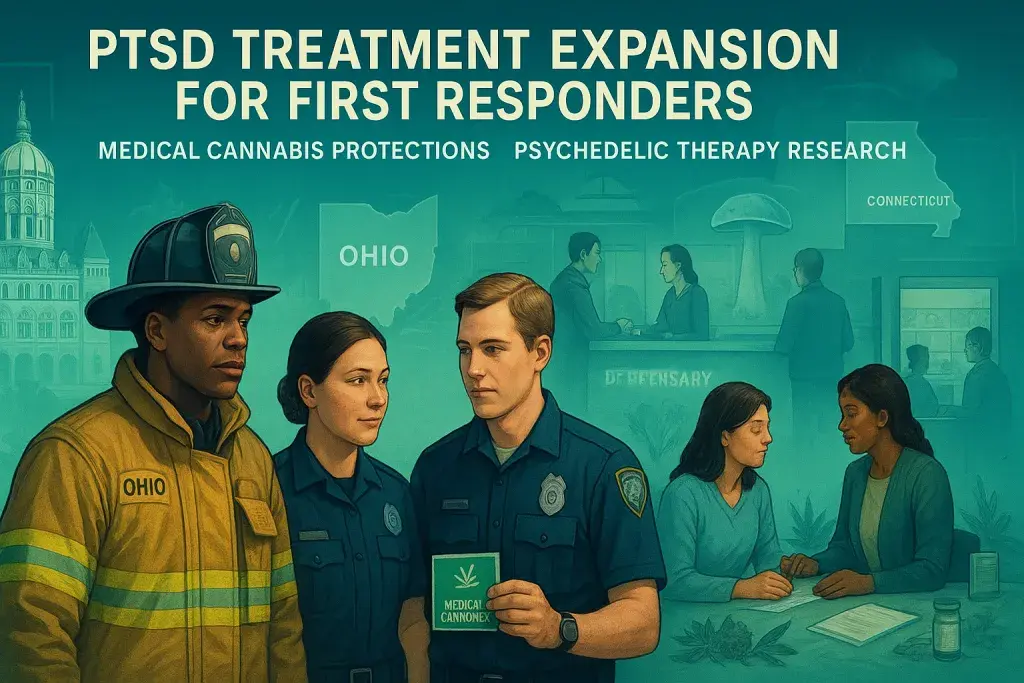
A quiet but meaningful policy shift is underway across several states: lawmakers are broadening the legal and medical frameworks available to firefighters, police officers, and emergency medical workers dealing with post-traumatic stress. Legislation passed in 2024 spans workplace protections for medical cannabis patients, new psychedelic-assisted therapy research programs, and state-funded commissions to help cover treatment costs. For licensed cannabis operators, particularly in medical markets, the implications reach directly into patient access, employment law, and the long-term regulatory posture of the industry.
Ohio stands out as an early mover. Republican Gov. Mike DeWine signed legislation creating a Post-Traumatic Stress Injury Commission tasked with reviewing applications from eligible first responders seeking financial assistance for treatment - a structural acknowledgment that current options are falling short. Ohio's medical cannabis market is well-established, and operators there are watching how the commission defines "eligible treatment" as that definition could eventually shape which therapies, including registered medical cannabis use, receive formal recognition. Dispensary operators in the state who serve patients in high-stress occupations should track the commission's rulemaking closely; to learn more about how Ohio's regulated cannabis market is structured, that context matters when anticipating where patient volumes and qualifying conditions may expand.
Maryland took a more direct route. Its new law - effective this October - protects firefighters, EMTs, paramedics, and other rescue workers from employment discrimination based on lawful off-duty use of medical marijuana. The protection applies specifically to registered medical cannabis patients who test positive for cannabis metabolites but show no signs of impairment while on duty. That's a meaningful distinction. It doesn't give workers a blanket pass on intoxication; it separates the presence of metabolites, which can linger in the body well after any psychoactive effect has passed, from actual on-duty impairment. For dispensaries serving medical patients in Maryland, this changes the conversation at the point of sale. Budtenders and patient-facing staff who understand this distinction are better equipped to counsel registered patients on what the law protects - and what it doesn't.
Psilocybin and Ibogaine Enter the Policy Conversation
Beyond cannabis, several states are moving to expand access to psychedelic-assisted therapies, which signals something important: policymakers are no longer treating PTSD among first responders as a problem that traditional pharmacology alone can solve. Connecticut expanded a Yale University pilot program studying psilocybin-assisted therapy, opening eligibility to any state resident 18 or older who meets the clinical criteria set by Yale's institutional review board. The program was previously restricted to veterans, retired first responders, and frontline health care workers. Missouri's legislature advanced - but did not send to the governor before adjournment - a bill that would allow veterans and first responders in approved research studies to access psilocybin and ibogaine under medical supervision.
Here's the catch for cannabis operators watching these developments: psychedelic therapy isn't a competitor to medical cannabis, but it is part of a broadening regulatory philosophy that could reshape how states think about controlled substances in a therapeutic context. If state legislatures grow more comfortable carving out supervised, evidence-based exceptions for Schedule I compounds, that comfort level tends to spill over - eventually - into how medical cannabis programs are evaluated, expanded, and funded.
What This Means for Medical Dispensary Operators
The operational implications vary by state, but a few threads run through all of them. First, employment protections tied to medical cannabis use are still fragmented and inconsistently written. Maryland's law is relatively specific. Other states offer narrower or no comparable protection. For multi-state operators running compliance programs across multiple jurisdictions, that patchwork creates real liability exposure - particularly when employee drug testing policies, HR documentation, and state-specific carve-outs don't align.
Second, the first responder population is a patient segment worth understanding precisely. Retired firefighters, paramedics, and law enforcement personnel dealing with PTSD often present as high-frequency, long-term medical cannabis patients - the kind of consistent, repeat customer that supports stable dispensary revenue in medical markets. As states formalize pathways for these workers to access treatment without risking their employment or benefits, the registered patient base in states with active medical programs could grow. That has downstream effects on wholesale demand, inventory planning, and the SKU mix dispensaries choose to stock.
Third - and this is worth stating plainly - compliance doesn't stop at the register. Dispensaries operating in states that now protect registered medical cannabis patients from employment discrimination carry an indirect responsibility to keep patient education current. That means training staff on what state law does and does not say, avoiding overstatement about what cannabis treats or cures, and pointing patients toward licensed health professionals rather than substituting budroom conversation for clinical guidance.
The Broader Regulatory Signal
What's striking across all of these legislative moves is the bipartisan character of them. Ohio's measure was signed by a Republican governor. Maryland's protections for medical cannabis patients passed in a blue state but track a policy logic - separating metabolite presence from impairment - that has been building in labor law discussions for years. The Connecticut and Missouri psychedelic therapy bills crossed traditional lines of political support.
The implication for the licensed cannabis industry isn't that the regulatory environment is loosening. It's that the frame is shifting - from prohibition-era risk management toward a more differentiated, evidence-adjacent model that acknowledges therapeutic context. That shift is slow, jurisdiction-specific, and reversible. But operators who understand where the policy momentum is heading tend to make better long-term decisions about market positioning, license strategy, and patient-facing program design than those who don't.