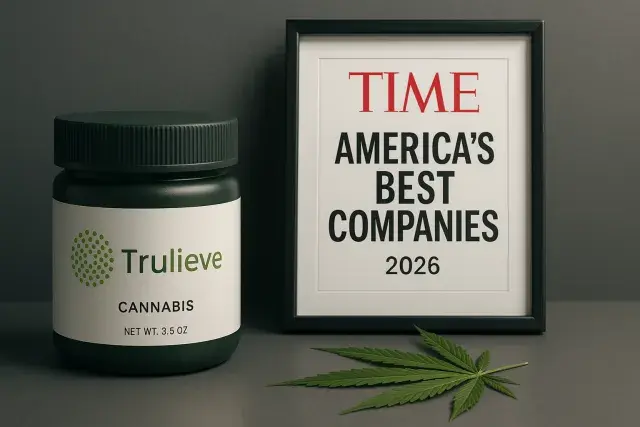

Trulieve has landed on TIME's 2026 list of America's Best Companies, one of just two cannabis operators to make the cut out of more than 7,200 companies considered. The list, compiled by TIME and Statista, ranks businesses on employee satisfaction, financial strength, and sustainability transparency - three metrics that rarely get attached to plant-touching companies in mainstream business coverage. Trulieve placed 921st, a modest slot in absolute terms but a notable one given the company it's keeping.
The recognition matters less as a trophy and more as a data point for an industry still fighting for basic legitimacy in the eyes of banks, landlords, and institutional investors. Cannabis companies operate under federal illegality, meaning standard credit lines, conventional insurance, and even routine software integrations often come with friction that other retail sectors don't face. Multi-state operators like Trulieve have had to build parallel infrastructure - proprietary seed-to-sale tracking layered on top of state-mandated METRC reporting, point-of-sale systems built specifically for regulated inventory, and compliance logs that would make a pharmacy auditor blink. In markets like Massachusetts, where regulatory scrutiny runs particularly tight, operators lean on specialized retail technology such as Massachusetts cannabis POS platforms to keep transactions, tax calculations, and inventory data aligned with state rules in real time. That kind of operational discipline is exactly what a metric like "financial strength" is quietly measuring, even if TIME's methodology doesn't say "seed-to-sale" anywhere in its criteria. Massachusetts cannabis POS
Why a Ranking Like This Carries Weight in a Federally Illegal Industry
Here's the catch with cannabis and mainstream business recognition: most national rankings simply exclude the sector outright, either from policy or from data-availability problems. Companies still operating under Section 280E of the federal tax code - which bars standard business deductions for companies trafficking in federally controlled substances - face profitability math that no other legal retail sector has to contend with. Employee satisfaction surveys, financial disclosures, and sustainability reporting all require a level of operational maturity that many younger cannabis operators haven't reached yet, given how recently many state markets opened and how much capital gets consumed just staying compliant.
So when a list built on employee sentiment and balance-sheet durability includes a cannabis operator at all, it signals something about how the company has built its back office, not just its front-of-house dispensary experience. Kim Rivers, Trulieve's CEO, framed the placement as a reflection of business durability rather than growth velocity - a distinction that matters in a sector where plenty of operators have expanded fast and then stumbled on debt service, wholesale price compression, or license-market oversaturation.
What It Signals for Operators, Landlords, and Investors
For dispensary owners and smaller multi-state operators watching from a distance, the takeaway isn't that TIME suddenly loves cannabis. It's that the operational bar for being taken seriously by mainstream capital markets keeps rising. Investors evaluating cannabis paper increasingly want to see the same things: clean compliance records, sustainable wholesale pricing relationships, defensible inventory shrinkage numbers, and workforce stability in an industry known for thin margins and high turnover in budroom and retail staff.
Landlords and payment processors weighing whether to work with cannabis tenants and merchants also read signals like this one. A federally illegal product line that nonetheless produces companies capable of meeting mainstream financial-strength benchmarks is a stronger argument for continued fintech investment in cashless payment solutions and point-of-sale infrastructure built specifically for compliant retail. None of that changes the underlying regulatory reality - cannabis remains restricted, age-gated, and subject to state-by-state testing, labeling, and packaging rules - but it does suggest the sector's most established operators are building the kind of institutional muscle that outlasts any single market cycle.