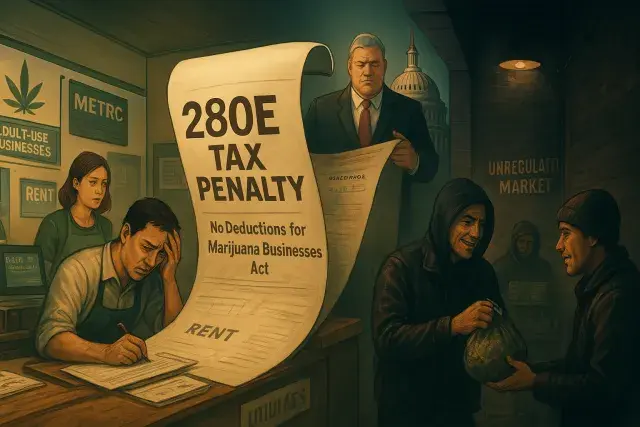
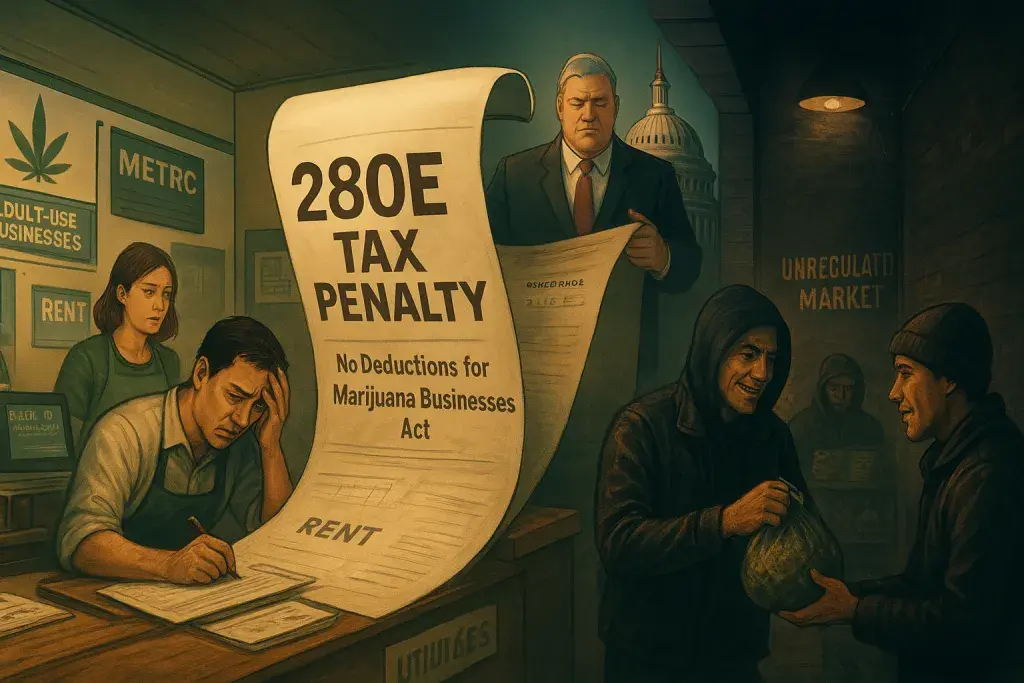
A small group of Republican members of Congress has introduced the No Deductions for Marijuana Businesses Act-legislation that would lock in the 280E tax penalty for state-legal cannabis businesses, regardless of how the federal government ultimately classifies the substance. The bill arrives at a peculiar moment: the Trump administration has moved medical cannabis into Schedule III, which would eliminate 280E for medical operators, and a hearing is underway on whether to extend that rescheduling-and the accompanying tax parity-to adult-use businesses as well. In other words, these members of Congress are working against their own executive branch's stated policy direction.
Section 280E, for those less familiar with the financial mechanics of cannabis retail, is a provision in the federal tax code that denies ordinary business deductions to companies trafficking in Schedule I or Schedule II controlled substances. That means a licensed dispensary cannot deduct rent, payroll, utilities, marketing, or most other standard operating expenses that any other small business takes for granted. The result is an effective tax rate that can run dramatically higher than what a comparable non-cannabis retailer pays-a structural disadvantage baked into every financial model, every wholesale purchase order, every budget projection a cannabis operator runs. For operators in competitive adult-use markets, where wholesale pricing pressure is constant and retail margins have compressed considerably, 280E is not a minor inconvenience. It is a meaningful threat to solvency. State-regulated markets like Massachusetts, where dispensary operators manage layered compliance obligations on top of federal tax exposure, feel this acutely; you can read more about the operational pressures facing licensed retailers in those environments.
Here is what makes the No Deductions for Marijuana Businesses Act particularly difficult to defend on its own terms: its sponsors are, by and large, members of a party that has spent decades positioning itself as the standard-bearer for small business tax relief. Reducing the tax burden on entrepreneurs, opposing punitive regulatory overreach, letting businesses keep more of what they earn-these are not fringe positions within the Republican coalition. They are central ones. Yet this legislation would explicitly carve out a category of state-licensed, heavily regulated small businesses and preserve their most punishing federal tax treatment. The intellectual consistency is not there. Fair enough if one opposes broader cannabis reform on policy grounds. But opposing it by cheering for a targeted small-business tax hike is a strange hill to occupy.
The Illicit Market Is the Real Beneficiary
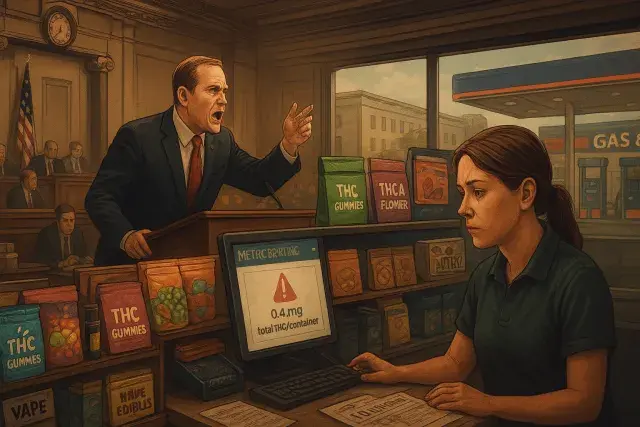
Set aside the tax philosophy contradiction for a moment and consider the practical outcome this bill would produce. Licensed cannabis dispensaries operate under extensive compliance frameworks-age verification at point of sale, seed-to-sale inventory tracking through systems like METRC, mandatory lab testing with certificates of analysis attached to every product batch, compliant packaging with child-resistant features and required labeling, and regular state audits. These are not optional layers. They are the cost of holding a license. And the data on age-gating at licensed dispensaries is consistently favorable; regulated operators have strong incentives and real enforcement exposure to card every customer.
The unregulated illicit market has none of that. No METRC entries. No COAs. No excise tax remittance. No age restrictions in practice. And critically-no 280E exposure, because illicit operators are not filing federal tax returns on cannabis income in the first place. Legislation that raises effective costs for licensed operators while doing nothing to address the illicit supply chain does not reduce cannabis access. It shifts market share. Some portion of the customers, particularly price-sensitive ones, who might otherwise purchase from a licensed dispensary will migrate toward cheaper unregulated sources. The compliance infrastructure that keeps products tested, labeled, and away from minors loses ground. That is the operational reality, even if it is apparently not part of the calculation being made on Capitol Hill.
What Rescheduling Actually Changes-and What Congress Could Disrupt
The DEA's movement of cannabis to Schedule III represents the most significant shift in federal drug scheduling in decades. For medical cannabis operators, the elimination of 280E under Schedule III would mean the ability to deduct cost of goods sold and ordinary business expenses-a structural correction that accountants, multi-state operators, and single-store dispensary owners have been anticipating for years. Pending hearings on whether adult-use cannabis receives the same classification could extend that relief across the regulated market.
The No Deductions for Marijuana Businesses Act is essentially an attempt by a minority of congressional members to override that trajectory through the tax code. Their letter to Treasury officials signals they want 280E's penalties preserved by statute, decoupled from scheduling status-meaning even if DEA formally moves cannabis to Schedule III or lower, the tax hammer stays. That is not a narrow technical dispute. It has direct implications for every cannabis retailer modeling their post-rescheduling finances, every investor underwriting new dispensary construction, and every brand negotiating wholesale supply agreements on margin assumptions that factor in eventual tax parity.
The Business Case for a Functioning Regulated Market
Roughly two-thirds of Americans support legal cannabis. More than three-quarters of states have enacted some form of medical or adult-use program. At this point, the argument that federal prohibition reflects majority public sentiment is not supportable. What the federal-state mismatch has produced instead is a patchwork of compliance burdens, banking constraints, tax penalties, and regulatory inconsistencies that licensed operators absorb every day while illicit competitors absorb none of it.
The push to preserve 280E does not strengthen public safety. It does not reduce cannabis consumption. What it does is weaken the financial footing of the very businesses operating under the regulatory oversight that legalization advocates and regulators have spent years building out. Licensed dispensaries track inventory down to the individual unit, report sales data to state regulators, pay excise taxes, and carry insurance. That infrastructure has value-not just for operators, but for the public interest argument that regulated markets are preferable to unregulated ones. Legislation designed to squeeze that infrastructure financially, at the precise moment federal policy is moving toward acknowledging it, is difficult to explain as anything other than opposition for its own sake. And that is a position that serves no one particularly well-not patients, not operators, not the public, and frankly not the Republican small-business brand either.